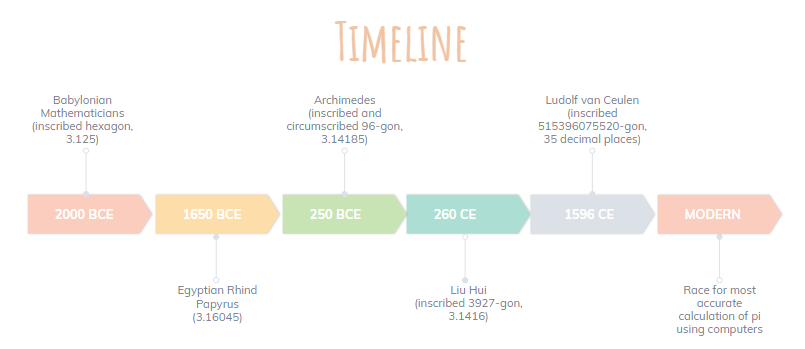
In 1936, a clay tablet was discovered covered with geometric figures that showed that the Babylonians, more than 4000 years ago, had estimated the value of what we now call “pi” to be 3.125 (Beckmann, 1933). That’s pretty darn good for 2000 BCE!
The “Rhind Papyrus”, a fifteen foot roll of ancient Egyptian math problems dating all the way back to 1650 BCE, has a problem that invites the student to compute the area of a circle using 3.1605 as the approximation for pi (Allen, 2017). While not exact, these ancient Egyptians’ estimation came surprisingly close to the real thing.
Archimedes, a mathematician from Syracuse, Italy, calculated a set of bounds for pi by inscribing and circumscribing some 96-sided polygons about a circle (an incredible thing to draw by hand!). He found that pi was between 223/71 and 22/7, approximating the number to be about 3.14185 (Rosenberg, 2003).
Liu Hui, considered by some to be The Father of Chinese Geometry, used a similar method as Aristotle to estimate pi - he inscribed a 3927-gon within a circle to calculate pi as approximately 3.1416 (Posamentier & Lehmann, 2004).
German mathematician Ludolf van Ceulen used a 515396075520-sided polygon, again, drawn by hand, to accurately calculate pi to 35 decimal places! This was so impressive that for some time pi was called the “Ludolphian number”, and van Ceulen’s wife had this number engraved on his tombstone after his passing (Posamentier & Lehmann, 2004).
Since the invention of the electronic computer in 1949, we have accurately calculated pi up to 105 trillion digits, and the race continues (Baker, 2024)! It seems this quest for calculating pi began at the dawn of time and will continue until the world’s end.
Did you know that pi makes an appearance in the Bible?
The Old Testament records the dimensions of a fountain built in King Solomon’s temple somewhere between 990 and 931 BCE in both 1 Kings 7:23 and 2 Chronicles 4:2. The verses read,

This fountain is said to have a circumference of 30 cubits and a diameter of 10 cubits. This gives us pi ≈ 30/10 = 3, a pretty crude estimation, but an 18th century rabbi by the name of Elijah of Vilna discovered that the Bible may have been more accurate than we thought. Much more accurate, in fact. The rabbi noticed that the symbols used for the words “a line” were different in the two verses. Using a biblical analysis technique called gematria, Elijah discovered that the symbol in 1 Kings 7:23 represented the number 111 and the symbol in 2 Chronicles 4:2 represented the number 106. “Using gematria in an accepted way, he then took the ratio of these two values: 111/106=1.0472 (rounded to four decimal places), which [Elijah] considered the necessary ‘correction factor.’ By multiplying the Bible’s apparent value of pi, 3, by this ‘correction factor,’ one gets 3.1416, which is pi correct to four decimal places (Posamentier & Lehmann, 2004)!”